

Note: Please check your Spam or Junk folder, in case you didn't receive the email with verification code.

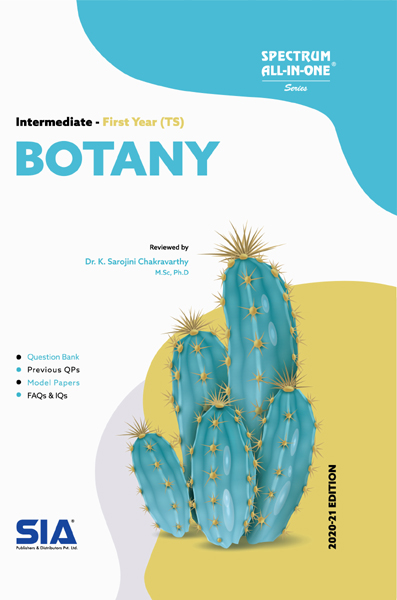
BOTANY (Inter First Year) Bi.PC
Syllabus
Unit-1
DIVERSITY IN THE LIVING VING WORLD
Chapter 1 : The living world
What is living? Diversity in the living world; Taxonomic categories and taxonomical aids.
Chapter 2 : Biological Classification
Five kingdom classification - Monera, Protista, Fungi, Plantae and Animalia, Three domains of life (six kingdom classification), Viruses, Viroids, Prions & Lichens.
Chapter 3 : Science of Plants - Botany Origin, Development, Scope of Botany and Branches of Botany.
Chapter 4 : Plant Kingdom
Salient features, classification and alternation of generations of the plants of the following groups –Algae, Bryophytes, Pteridophytes, Gymnosperms and Angiosperms.
Unit-2
STRUCTURAL ORGANISATION IN PLANTS- MORPHOLOGY
Chapter 5 : Morphology of flowering Plants
Vegetative :
Parts of a typical Angiospermic plant; Vegetative morphology and modifications- Root, Stem and Leaftypes; Venation, Phyllotaxy.
Reproductive:
Inflorescence – Racemose, Cymose and special types ( in brief).
Flower : Parts of a flower and their detailed description; Aestivation, Placentation.
Fruits : Types- True, False and parthenocarpic fruits.
Unit-3
REPRODUCTION IN PLANTS
Chapter 6 : Modes of Reproduction
Asexual reproduction, binary fission, Sporulation, budding, fragmentation, vegetative propagation in plants, Sexual reproduction in brief, Overview of angiosperm life cycle.
Chapter 7 : Sexual Reproduction in Flowering Plants
Stamen, microsporangium, pollen grain. Pistil, megasporangium (ovule) and embryo sac; Development
of male and female gametophytes.
Pollination – Types, agents , Out breeding devices and Pollen – Pistil interaction.
Double Fertilization; Post fertilisation events: Development of endosperm and embryo; development of seed, Structure of Dicotyledonous and Monocotyledonous seeds, Significance of fruit and seed.
Special modes – Apomixis, parthenocarpy, polyembryony.
Unit-4
PLANT SYSTEMATICS
Chapter 8 : Taxonomy of Angiosperms
Introduction
Types of Systems of classification (In brief).
Semi-Technical description of a typical flowering plant
Description of Families: Fabaceae, Solanaceae and Liliaceae.
Unit-5
CELL STRUCTURE AND FUNCTION
Chapter 9 : Cell – The Unit of Life
Cell- Cell theory and cell as the basic unit of life- overview of the cell. Prokaryotic cells, Ultra Structure of Plant cell (structure in detail and functions in brief), Cell membrane,
Cell wall, Cell organelles: Endoplasmic reticulum, Mitochondria, Plastids, Ribosomes, Golgi bodies, Vacuoles, Lysosomes,
Microbodies, Centrosome and Centriole, Cilia, Flagella, Cytoskeleton and Nucleus.
Chromosomes: Number, structural organization; Nucleosome.
Chapter 10 : Biomolecules
Structure and function of Proteins, Carbohydrates, Lipids and Nucleic acids.
Chapter 11 : Cell cycle and Cell Division
Cell cycle, Mitosis, Meiosis - significance.
Unit-6
INTERNAL ORGANISATION OF PLANTS
Chapter 12 : Histology and Anatomy of Flowering Plants
Tissues - Types, structure and functions: Meristematic;
Permanent tissues - Simple and Complex tissues.
Tissue systems - Types, structure and function: Epidermal, Ground and Vascular tissue systems.
Anatomy of Dicotyledonous and Monocotyledonous plants - Root, Stem and Leaf.
Secondary growth in Dicot stem and Dicot root.
Unit-7
PLANT ECOLOGY
Chapter 13 : Ecological Adaptations, Succession and Ecological Services
Introduction.
Plant communities and Ecological adaptations: Hydrophytes,
Mesophytes and Xerophytes.
Plant succession.
Ecological services – Carbon fixation, Oxygen release and pollination (in brief).
 No Preview is available for this book
 Get 100 instant uPoints on the purchase of Rs.100 or above for each order.
CategoriesGeneral Science

Format EPUB

TypeeBook


 0
0
 Facebook
 Twitter
 Email
Email